“Central to the new-music experience in New York.”
– Time Out NY
“Central to the new-music experience in New York.”
– Time Out NY
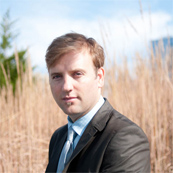
Runnegackonck Presencing
Site-determined work for TILT Brass Sextet
Video of the premiere, May 20th, 2016
Opening of Naval Cemetery Landscape at Brooklyn Navy Yard
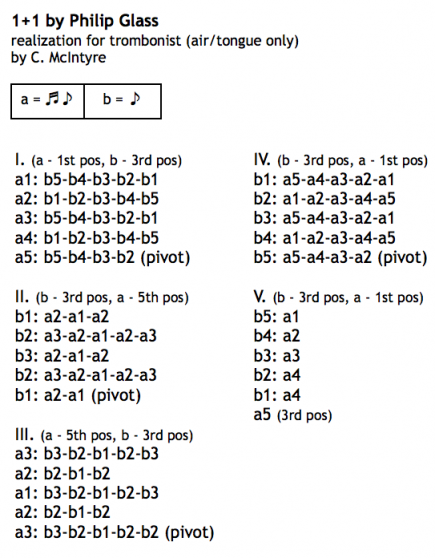
Live performance by CJM during 2006 MATA Benefit at Paula Cooper Gallery. A realization for trombone by McIntyre of this very early work by Glass which is originally for "one player and amplified table top."
1+1 page on philipglass.com
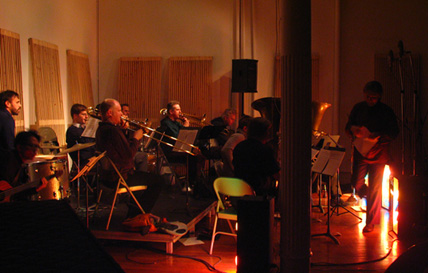
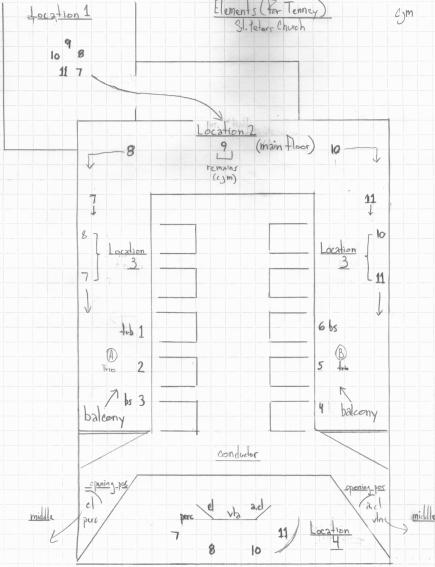
A performance of Fredric Rzewski's 1969 work "Last Judgment - for solo trombone or several echoing trombones not quite in unison" by Chris McIntyre's 7X7 Trombone Band and Friends during In Memory of Suzanne Fiol at St. Ann's Church, Brooklyn, NY on Nov. 15, 2009.
Audience right (front to back):
Chris McIntyre
Brian Drye
Jen Baker
Stephen Swell
Peter Zummo
Audience left (front to back):
James Rogers
Deborah Weisz
Ben Gerstein
William Lang
Monique Buzzarté
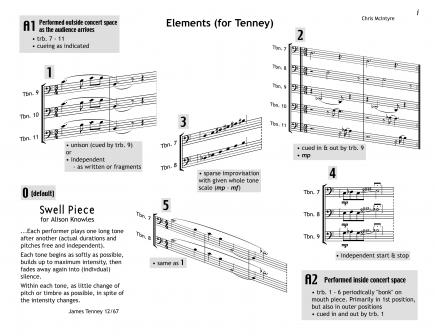
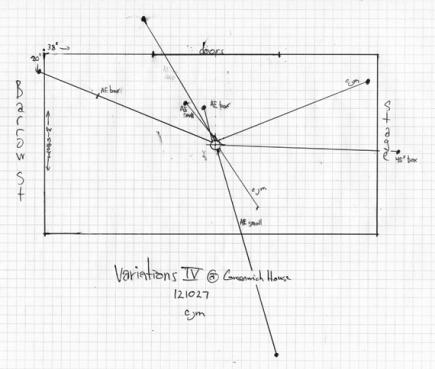
Recording from Greenwich House Music School performance on Saturday, October 27th, 2012. Event on cmcintyre.com
Image is the score from 10/27/12
V4 on johncage.org
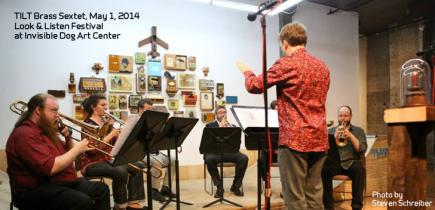
Fabrics 1 (2014) from Dedifferentiation with Brass
for TILT Brass Sextet (3 trumpet, 3 trombone)
Premiere on May 1st, 2014 during 2014 Look & Listen Festival
Recording Info:
TILT Brass Sextet
Time Leopold, Mike Gurfield, Steph Richards - trumpet
Jen Baker, Jacob Garchik, James Rogers (bs) - trombone
Audio recording by Bill Siegmund, Digital Island Studios, NYC
Broadcast online at Q2 Music
Complete concert recording and info at
http://www.wqxr.org/#!/story/look-and-listen-presents-bracing-new-works-accordion-and-brass/
TILT Creative Brass Band
3 trumpet, 2 tenor trombone, 1 bass trombone, 2 French horn, tuba, percussion
Premiered by TILT Creative Brass Band, Nov.11, 2009 at Roulette Intermedium
Additional Performances:
ISSUE Project Room, March 3, 2010
Released on To TILT: Volume One - Original Music for TILT Brass
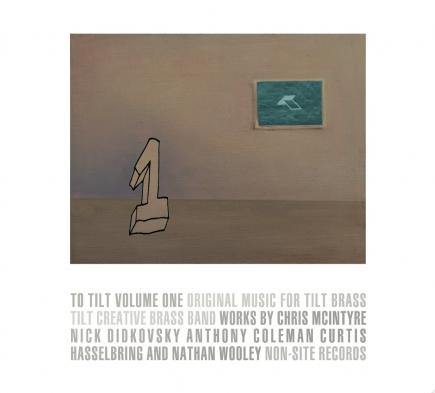
LoTILT (SIXtet & LoTET)
Folio score for 2 trumpet, 2 trombone, 2 tuba, bass clarinet, bass sax, 2 perc, elec bass, laptop
Premiered by TILT Brass & Lotet (LoTILT), Dec. 10, 2006 at Roulette Intermedium
Commissioned by Roulette and Jerome Foundation
More about Metaxis folio score project ⥤
TILT SIXtet
2 trumpet, 2 trombone, 2 tuba (laptop)
Premiered by TILT Brass' SIXtet, May 9, 2007 at Diapason Gallery
Additional Performances:
ISSUE Project Room, February 6, 2008
Cornelia Street Café, November 10, 2008
Ibeam, April 18, 2009
5 brass instruments and percussion
First performed by members of TILT Brass, March 24, 2004, Barbés, Brooklyn
Barbés personnel:
Herb Roberts, Nate Wooley - trumpet; Mark Taylor - horn; Chris McIntyre - trombone; Julie Kalu - tuba; Kevin Norton - percussion
trombone and piano
Incidental music for Monuments, a film by Redmond Entwistle.
Premiere screening at Art In General, Jan. 21st, 2010
Monuments 2010, 29 minutes, 16mm, color
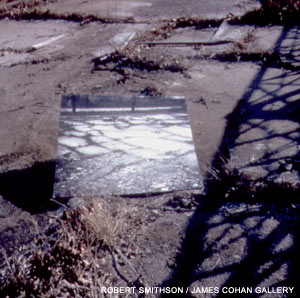
E-set No. 1 is the initial piece from Phono-Markers, a folio of works for solo trombone. Like other recent works, Phono-Markers use cyclic data patterning to generate crystallographic forms. Phono-Markers are part of my on-going Smithson Project, a body of material for various sonic media inspired by the work, writings, and inspirations of visual artist Robert Smithson.
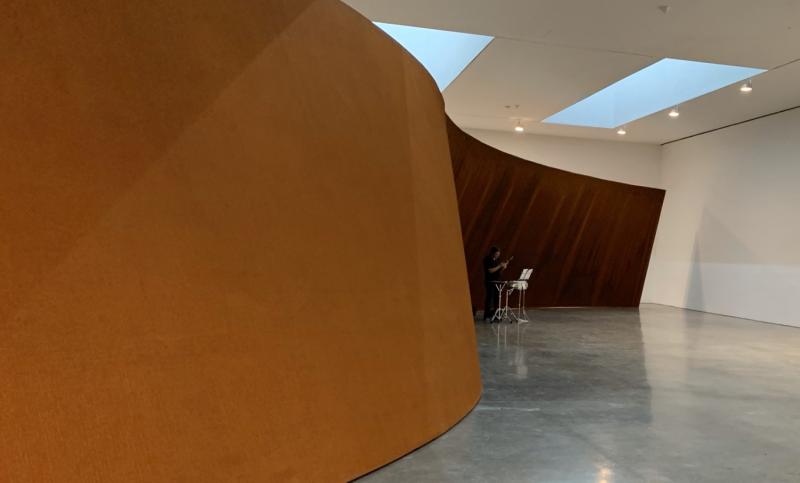
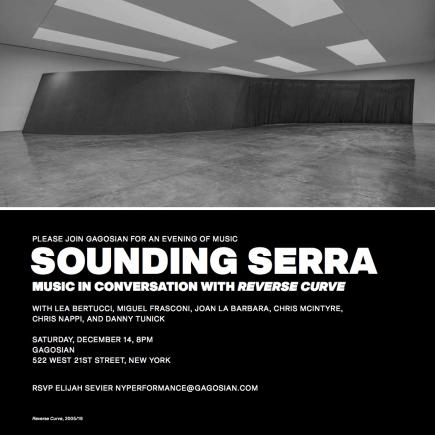
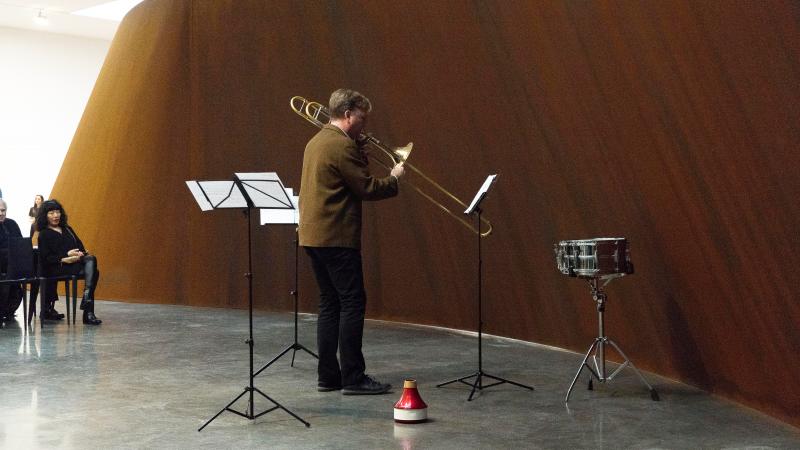 Reverses (2019) is a musical response to Richard Serra’s massive sculpture Reverse Curve (2005/2019) which was installed at Gagosian Gallery’s 21st Street gallery where the piece was performed. Reverses acknowledges and utilizes the acoustic characteristics of the large, resonant gallery space in which the music and sculpture coexisted. Employing the diffusion created by brass and percussion in an extremely reverberant room, the piece attempted to establish an analogous sonic experience to the steel sculpture and its bisection of the space. It did this by locating a duo of trombone and percussion (playing snare drum) on opposing sides of the sculpture where they exchange material back and forth in an accretional and elided formal system, a sort of simplified prolation canon that acknowledges the lingering resonances of each iterated sound. Many thanks to percussionist and event curator Danny Tunick for his efforts.
trombone septet
Stuplimity No.1 (2005) by Chris McIntyre (composer), 7X7 Trombone Band
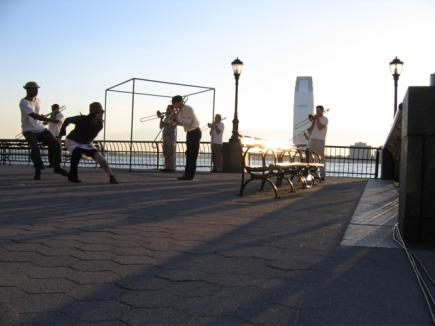
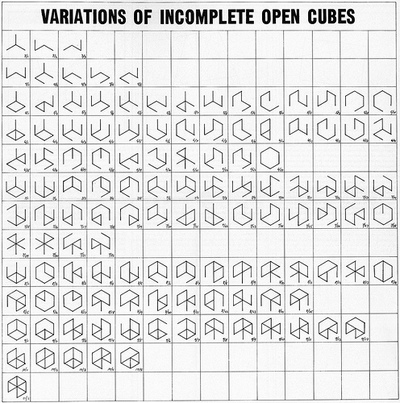
Stuplimity No.1 incorporates elements used by artist Sol LeWitt in his series of works grouped under the title Variations of Incomplete Open Cubes (1974). This transliteration was a response to the 7x7 ft cubic structures used by Director/Choreographer Yoshiko Chuma in 7X7X7X7X7, the site-determined intermedia work in which the pre-final version of Stuplimity No.1 was heard. The outdoor site that Chuma's larger work occupied was near the Hudson River's North Cove in Battery Park City, NYC. This was one of several performance sites along the river during the event Art On The Beach: Revisited during the 2005 River To River Festival.
Premiered durring City Center's Fall For Dance Festival, Oct. 7th, 2005
by 7X7 Trombone Band
Commissioned by choreographer Yoshiko Chuma and the School of Hard Knocks
Additional Performances:
2005 River To River Festival (earlier version: stuplimity: river), June 2 & 3
> NY Times review
2006 ISSUE Project Room (Carroll St silo & grounds), June 29 & 30
2007 The Stone, NYC, June 1
for solo trombone and live-electronics
Premiered by the composer, Brooklyn Lyceum, March 21, 2007, during the 2007 MATA Festival
Additional Performances:
iQuit Music Series, Rogue Buddha Gallery, Minneapolis, May 17, 2007
Ne(x)tworks' Music Without Dance Fest at Greenwich House, Feb. 26, 2012
Program Note (from premiere):
The third piece in my stuplimity series continues a process of exploring temporal and sonic perception, with the idiomatic and timbral qualities of trombone as the medium. no. 1 is for septet, no. 2 is for five or more (there is also a trio version of no.1). This solo iteration furthers the downward scaling process, but the addition of live-electronics (via MAX/MSP) creates a sort of parallel upscaling of sonic probabilities.
I came across the title, a neologism combining stupefy and sublime, while reading an essay on Sol LeWitt's multiple media and format series Variations of Incomplete Open Cubes. Sianne Ngai, the literary theorist who coined the term, offers a definition: "...in experiencing the sublime one confronts the infinite and elemental; in stuplimity, one confronts the machine or system, the taxonomy or vast combinatory, of which one is a part." At the time, I was in the process of creating stuplimity no.1 for a collaboration with choreographer Yoshiko Chuma, who also commissioned no.2. Chuma utilizes several 7x7 foot metal-frame cubes in her work, and I was looking to LeWitt for some intertextual inspiration. The conceptual thread I'm following is heavily influenced by Variations: textural and thematic material recurs throughout, but in varying degrees of transformation and temporality. This performance is dedicated to Leroy Jenkins.
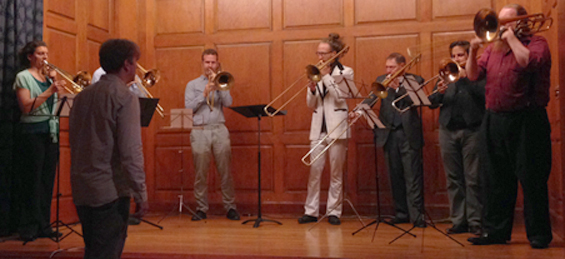
Tilted Arc (2014) for trombone septet and sound media is part of Presencing Piece No. 1 (Fed Plaza). Premiered on August 9th, 2014, Presencing Piece No.1 is a collaborative site-specific work employing music performance and 10-channel speaker system to present sounds concieved with Jacob K. Javits Federal Building Plaza in Lower Manhattan in mind. The excerpt recording is from a preview performance at South Oxford Space, Brooklyn, on May 31, 2014.
Personnel at South Oxford Space:
Trombone
Jen Baker, Jacob Garchik, Sam Kulik, Will Lang, Matt Melore, James Rogers, and Peter Zummo
Live Electronics
Chris McIntyre
improvising stratetgy for 2 or more performers
for Ne(x)tworks
Premiered on May 19th, 2005, ISSUE Project Room
Additional Performances:
Roulette Intermedium, December 8, 2006
Program Note:
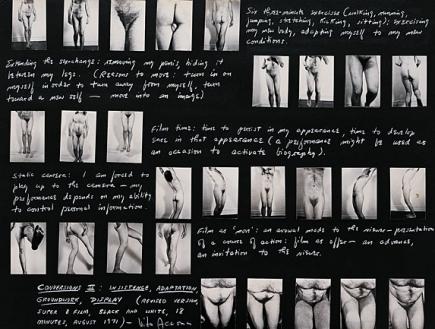
Inspired by a work of Vito Acconci's from 1971, Conversions (2005) explores basic sonic transformation using simplified, binary relationships. While any musical parameter could theoretically be "problematized" into a binaristic transformation, only the ambiguous element of timbre has been addressed in performance. Ideally, a range of elements (duration, frequency, amplitude, etc.) could be run through the stark process of Conversions (either diachronically or synchronically). Beyond the basic unifying goal of continuous tranformation, each performance is intended to be a unique sonic environment for performer and audience alike.
trumpet, French horn, bass trombone, Nord Lead synth, soundtrack
part 1 premiered by B3+ & McIntyre, March 4, 2008, Settepani Restaurant, Harlem
B3+ Brass Trio - David Taylor (bs trb), John Clark (hrn), and Franz Hackl (trp)
Commissioned by Composers Concordance.
Premiere of complete set at ISSUE Project Room, March 28, 2009
Josh Frank (trp), Mike Atkinson (hrn), Dave Nelson (bs trb), and composer (Nord)
string quartet and piano
for Ne(x)tworks
Premiere at Chelsea Art Museum, May 3, 2008
Additional Performances:
(le) Poisson Rouge, April 1, 2009 (2009 MATA Festival)
Program Note:
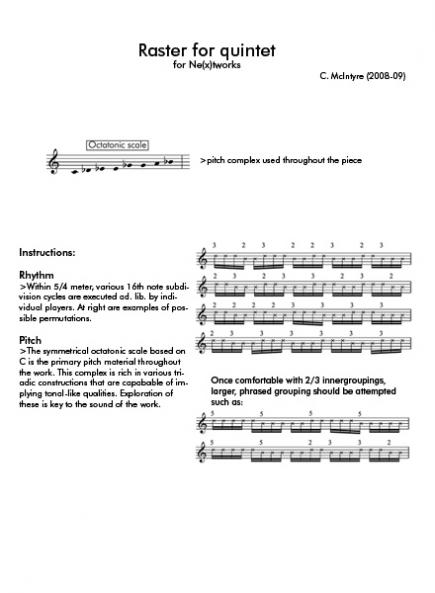
Raster for quintet (2008-09) builds on conceptual aims I've been developing in my compositions for Ne(x)tworks and elsewhere. My goal in previous works has been to challenge listeners' aural memory and listening patterns by presenting thematic and rhythmic ideas in abstract contexts, and then recalling them in various guises and evolved iterations. In relation, Raster is much more direct. I've chosen fairly audible rhythmic and pitch constructs to address these earlier concerns. The players are given both precisely written and clearly delimited indeterminate tasks. Unlike much of my music, this material occurs within a pulsed environment, albeit of a constantly shifting character. Instead of removing isometric time to create a quasi-static listening space, Raster creates stasis by continually reshaping time as it occurs. I've also limited the pitch material to tightly controlled arrays ostensibly adding to the static-yet-evolving profile of the work.
string quartet, piano/synth, harp, glass, trumpet, trombone, electronics, multiple soundtracks
for Ne(x)tworks
Original version premiered at Issue Project Room, May 28, 2004
Current version premiered at Roulette Intermedium, Dec. 8, 2006
"It is from zero, in zero, that the true movement of being begins."
Kasimir Malevich
Sigmar [unknown source] (2005/06) is inspired by the work of German visual artist Sigmar Polke. It utilizes several organizing principles. Based primarily in time increments, Sigmar obliquely incorporates appropriated bits of musical material (chordal statements from Stravinsky's Symphony In C, cells from Terry Riley's In C), as well as several pitch sets created for limited improvisation. Pre-recorded soundtracks are heard from various playback devices and locations throughout the space, acting as a canvas on which ensemble material is applied.
The Shape of Time (from Smithson Project)
I. synchrony
II. vis a tergo
III. diachrony
string quartet, piano, voice, harp/baritone guitar, percussion and electronics
The Shape of Time is a large ensemble work that is part of my on-going Smithson Project, a set of works for different sonic media inspired by the work, writings, and inspirations of visual artist Robert Smithson. The title is taken from Kubler's book of the same name, a work which heavily influenced Smithson. The Shape of TIme is in 3 continuous sections.
Premiere by Ne(x)tworks and JACK Quartet at The Kitchen, NYC
December 16 & 17, 2011
trumpet, trombone, and soundtrack (stereo)
Premiered by Ne(x)tworks, June 6th, 2003 Chelsea Art Museum
Brian McWhorter - trumpet, CJM - trombone
Additional Performances:
ISSUE Project Room, Oct. 12, 2006 (Peter Evans - trumpet)
Roulette, December 8, 2006 (Nate Wooley - trumpet)
Program Note:
VOIDS (2003)
I. in 0
II. ²
III. L
IV. mkg
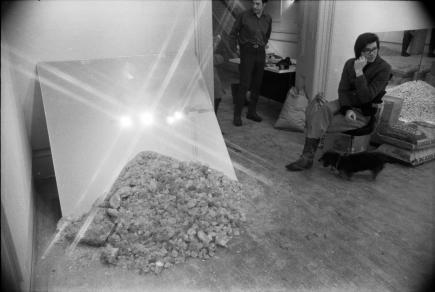
VOIDS (2003) is a work in four short movements for improvising trumpet and trombone duo with soundtrack. A very early piece in my compositional life, the score for VOIDS is primarily instructional. It premiered at Chelsea Art Museum in June 2003 during the creative music group Ne(x)tworks' debut concert. The work is a poetic musical response to the experience of existing on the streets of New York on 9/11/01. Each movement deals with a single physical "void": historical, forgotten, or little considered public spaces located in the constantly evolving phenomenological realm known as Manhattan Island.

Tumblr for Presencing Piece No.1
Created and Directed by Chris McIntyre
In collaboration with TILT Brass, Ed Bear, Tristan Shepherd, and David Shively
Programed and Funded by NYC Dept. of Transportation for its annual SummerStreets program.
Conceived by composer and trombonist Chris McIntyre, "Presencing Piece No.1 (Fed Plaza) " is a collaborative site-specific work using music performance and sound installation conceived for presentation at Jacob K. Javits Federal Building Plaza in Lower Manhattan. The piece utilizes spatialized acoustic and amplified sound along with broadcast media (infrared transmission and wireless internet) and public interaction (infrared sensors) to activate and articulate dimensionality within the site. Non-linear natural (geologic/geographic) and social (Native to Colonial to Federal) histories influence and provide the sonic, textual, and spatial content of the work, with special attention given to Richard Serra’s site-specific sculpture "Tilted Arc" (1981). March 2014 marked the 25th anniversary of its removal from the site, and the complex dialogic between Serra’s work and the plaza acts as a primary relationship for examination via sonic means in "Presencing Piece No.1 (Fed Plaza)."
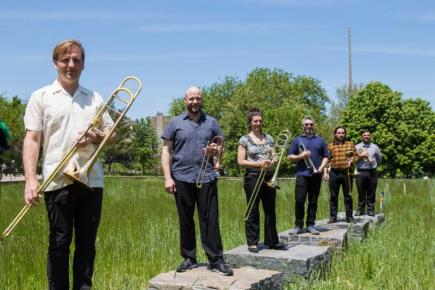
for TILT Brass Sextet (3 trumpets, 3 trombones)
Commissioned by Brooklyn Greenway Initiative and premiered on May 20, 2016, Runnegackonck Presencing is site-specific work created for the opening of Naval Cemetery Landscape at Brooklyn Navy Yard. The work is named after the ancestral creek that meandered around the Hospital and Cemetery grounds on its way to Wallabout Bay.
Sound work (stereo & 6 channel versions) - 7:48 min.
6-channel version premiered during 2010 MATA Festival at (le) Poisson Rouge's Gallery Bar, April 20, 2010
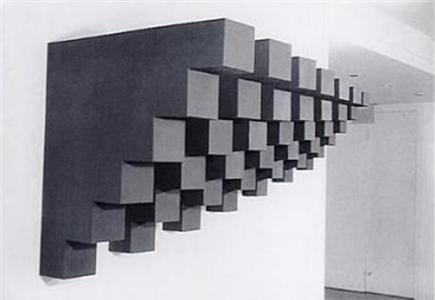
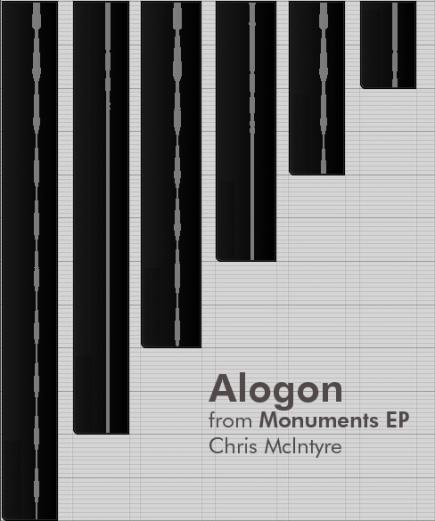
Conceived originally for a six discreet channel playback, Alogon is a structuralist work for pure synthesizer tones. It's an attempt at a formal transliteration of visual artist Robert Smithson's work of the same title from 1966.
Sound work (stereo & 6 channel versions) - 14:30 min.
6-channel version premiered during 2010 MATA Festival at (le) Poisson Rouge's Gallery Bar, April 21, 2010
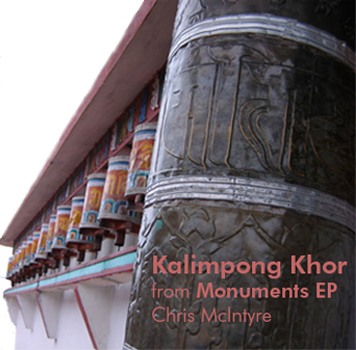
Kalimpong Khor is a work of musique concrete created primarily using field recordings made in Kalimpong, West Bengal, India, including at Zang Dhok Palri Phodang, a Tibetan Buddhist Temple. Also heard are sounds made with a Nord Lead 2 synth.
sound work (stereo, 8 & 16 channel versions), 20 - 40 minutes
16-channel version premiered at ISSUE Project Room, Oct. 12, 2006
Additional Presentations:
Brooklyn Lyceum, March 31 - April 4, 2008 (2008 MATA Festival)
silOM uses field recordings made in and around ISSUE Project Room’s Carroll Street silo space on the Gowanus Canal, creating a non-linear, quasi-narrative sound world that depicts the arrival, preparation, and presentation of a concert at this unusual location.
Stone Stratum (2017) 5:33
UllU (Chris McIntyre & David Shively)
Mixed & Produced - Chris McIntyre; Sound Sources - David Shively
All sounds sourced from a live performance by UllU (Chris McIntyre & David Shively) on March 27th, 2013 at The Stone in New York City.
Included on the compilation release Notes from Sub-Underground, a project put forth by over 50 artists from across multiple disciplines and practices to support the American Civil Liberties Union. Organized by Travis Just and Kara Feely.
stereo soundtrack for digital video, 8:22 min.
Video by José Alvarez
Premiered at Ratio3 Gallery, San Francisco, Jan. 8, 2010
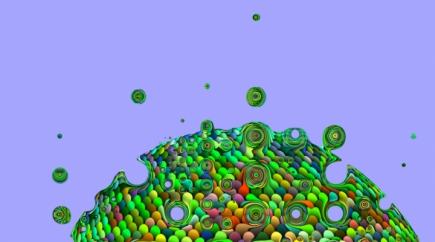
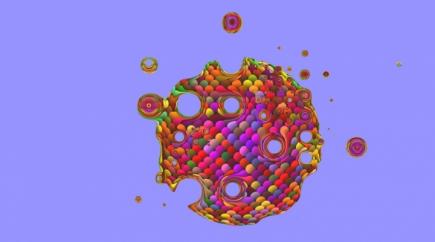
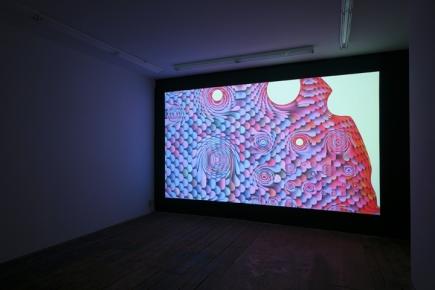
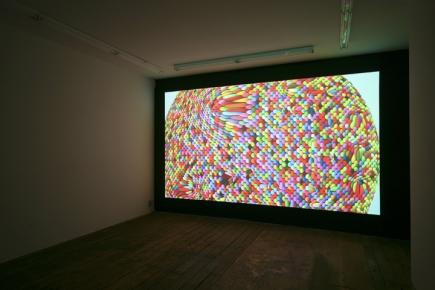
Images 1 & 2 - Stills from Alvarez video
Images 3 & 4 - Installation views from Ratio3 Gallery