“Central to the new-music experience in New York.”
– Time Out NY
“Central to the new-music experience in New York.”
– Time Out NY
Heather Kravas overly merry
May 3, 4, & 5, 2024
5/3 – 7:00pm
5/4 & 5 – 2:00pm
Chocolate Factory Theater
38-33 24th Street, Long Island City
TILT Brass Kravas Band
Jen Baker, Terry Green II, Sam Kulik, Chris McIntyre – trombone; Kavi McIntyre – trumpet; Ryan Sawyer, Dennis Sullivan – perc.
Drawing by Valentina Starkie, inspired by Remy Charlip

TILT Brass - Quintettes
Sisters Bklyn
Part of Sam Weinberg 2024 Residency
Tuesday, June 18, 2024
8:00pm, $10-30 sliding scale
Sisters
900 Fulton St, Brooklyn, NY 11238
Sisters' Calendar
June 18 lineup
• TILT Brass
• Sam Weinberg solo
• Sam Ospovat with Peter Evans, Brandon Seabrook, and John Hebert
Part of stellar saxophonist/composer Sam Weinberg’s monthly 2024 Residency, TILT Brass samples contemporary work for the conventional brass quintet by composers such as Steve Martland, Reena Esmail, and presents the premiere of a new piece for brass and synth by TB Director Chris McIntyre. This is TILT’s first performance at the excellent bar & restaurant Sisters in Clinton Hill, Brooklyn.
TILT Brass Quintet
Wayne DuMaine, Hugo Moreno - trumpet
Chris McIntyre - trombone, Kyra Sims - horn
James Rogers - bass trombone & tuba
Other guests TBA

TILT Brass photo by Stefan Raduta
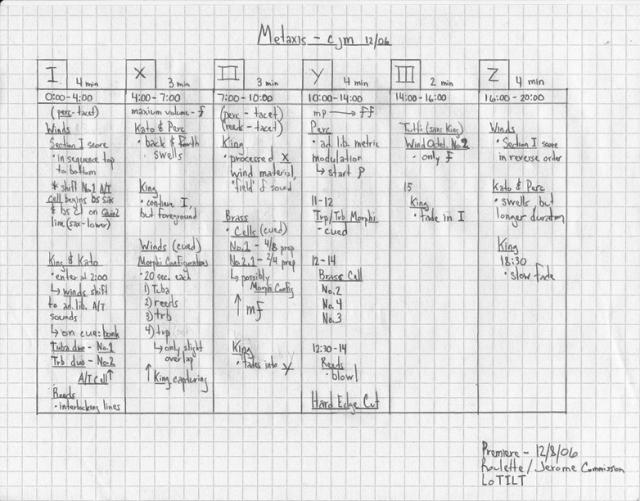
Metaxis 1 (2006)
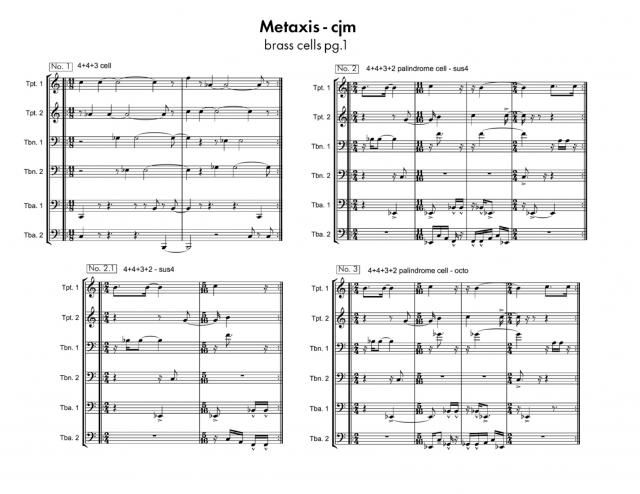
Folio score for 2 trumpet, 2 trombone, 2 tuba, bass clarinet, bass sax, 2 perc, elec bass, laptop
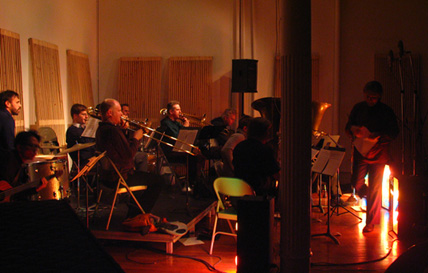
Premiered by TILT Brass & Lotet (LoTILT), Dec. 10, 2006 at Roulette
Commissioned by Roulette and Jerome Foundation
Metaxis 2 (2007)
2 trumpet, 2 trombone, 2 tuba & soundtrack*
* recording of live laptop performance by John King
Version 2.0 premiered by TILT SIXtet, May 9, 2007 at Diapason Gallery
Additional Performances:
2.1 - ISSUE Project Room, February 6, 2008
2.2 - Cornelia Street Café, November 10, 2008
2.2 - Ibeam, April 18, 2009
From Metaxis 1 folio score
Performance Note
Metaxis is a collection of notational and strategic material for a large ensemble of creative musicians. Each performance has an element of customization, i.e. an event or ensemble-specific micro-form is developed utilizing the various materials contained within the macro-form of the folio score. Included in the first iteration of the folio (created December '06) are the manuscript micro-form and instructions for laptop and electric bass from the first performance, and several notation pages for winds, brass, and percussion. Future generations of the score will contain additional material developed over the life of the piece. Additional micro-forms will be created by the composer (in collaboration with his own ensembles and by commissioned request), or by individual or group decision-making based on the available collection of material.
Aesthetic Note
The aesthetic of Metaxis is derived from my experiences with performative sound art, free improvisation, and "open score" notation. The technique of inserting predetermined types of material into varying textural/formal contexts is not a new one. On the contrary, it has played a primary role in some of the most probing creative music I know. Of great influence in this regard are Earle Brown's Available Forms, Anthony Braxton's Ghost Trance Music, James Saunders' #[unassigned], and James Tenney's theoretical concept of aural gestalten. My personal approach attempts to address a specific type of interactive and evolutionary music making, whereby the specific grouping of players and instruments gathered, with their individual creative talents, give a unique character to the work despite the fact that the material carries over from performance to performance. A successful execution of this music will (I hope) create a strong feeling of collectivity among the players, and, after multiple performances, affect ensemble memory and sense of temporality.