Elements (for Tenney)

2006

10 tenor trombone, 1 bass trb, Bflat clarinet, Eflat alto clarinet, violin, perc.

Premiered by Flexible Orchestra, April 28th, 2006 at St. Peter's Church, NYC

Commissioned by Downtown Ensemble/Flexible Orchestra


Program Note (from April 2006 premiere):

Last May, I participated in a series of events focusing on James Tenney's music. We played and listened to a number of pieces from his remarkably wide ranging output, all of which had a profound impact on my musical thinking. Since that time, I've written a number of pieces that incorporate concepts absorbed from Tenney's work, albeit viewed through my perceptual lens. After recently (and finally) reading his seminal book Meta Hodos, which solidified some thinking I'd been doing on my own, I decided to thank him (as he's done for so many colleagues) with the piece on tonight's program. Also, meeting and playing with Daniel Goode during those May '05 performances played a key role in my involvement with the Flexible Orchestra, so honoring Tenney seemed appropriate.

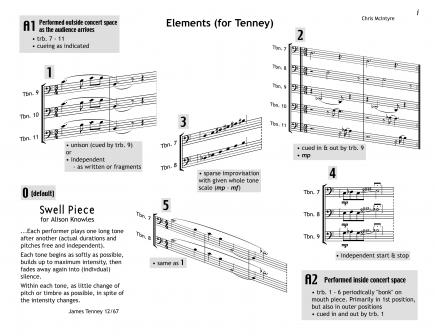
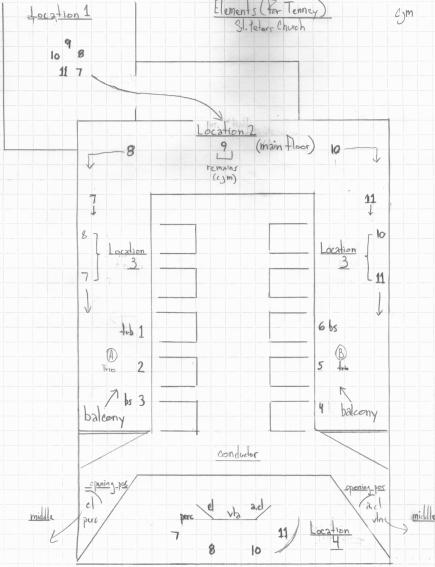
In Elements (for Tenney), a quintet of trombonists is "installed" outside the space prior to the performance. In varying locations, they execute material culled from my own recent compositions (fragments and complete "cells"), as well as miniature performances of Tenney's Swell Piece (for Alison Knowles).  Inside, obfuscated musical activity is taking place; nearly unheard sounds, yet the musicians exert physical and artistic energy in their creation. The quintessential "theme" introduces the present. Trombone duo and quartet iterations accrue as a sextet of players conjoin. The quintet enters (both physically and sonically) with revolving glissandi, insinuating its sound in alterity. The theme is exploded in degrees as the quintet traverses the perimeter, convolving further with the sextet's sonority. A group of "non-trombonists" appears gradually, while a soloist reaches from behind. Other's join, filling the space with small pieces of the harmonic puzzle.
 
A new, vigorous rhythmic module (repetitive yet circular, harmonically elusive), and the full ensemble is set into motion. Several vertical, pyramidical iterations occur, sculptural manifestations freezing the pitch environment momentarily. Isomorphism sublimates into improvisation, setting up a layered metamorphic exploration of the work's past, present and future. Tenney's "available pitches" ultimately reassign our listening attention with glacial richness, pushing aside all that preceded them. The glorious gestalt embodied in the sound of trombones in consort.